
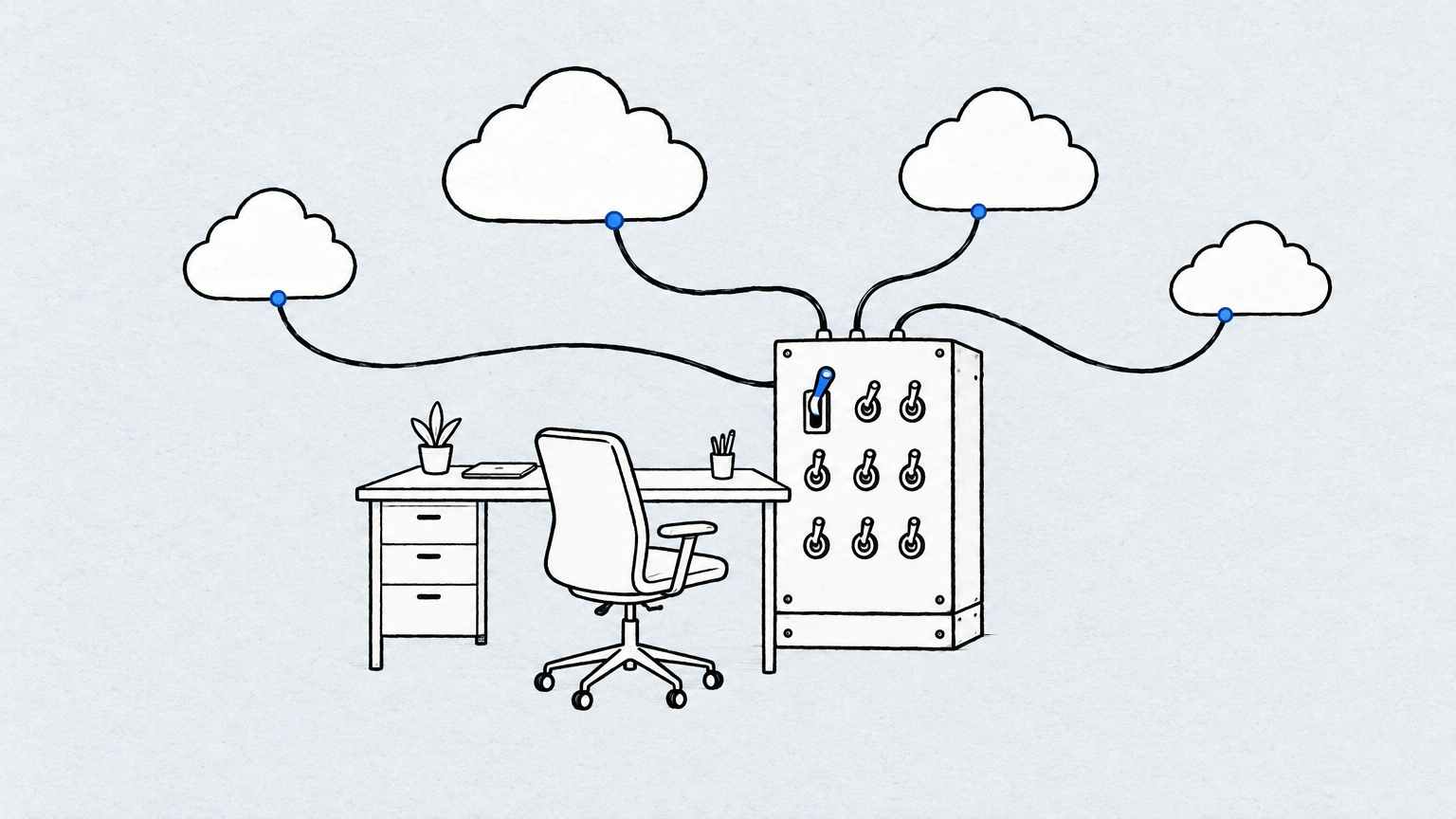
OpenAI's Model Failover Guide Leaves One Question Unanswered: Who Owns the Switch in a 20-Person Company?
On October 14, 2026, the OpenAI Developer Blog published "Designing failover across OpenAI model providers", an engineering guide to resilience across model providers. Its final section is titled "Who owns recovery?", but the article assumes you have a gateway, a router, evals, and named on-call owners. In a 20-person company, the reality is usually that "production routing" means 20 employees signing into ChatGPT separately. This article breaks down the verifiable facts in the guide and gives a smallest workable approach for a company with one person who can own the decision.
On October 14, 2026, the OpenAI Developer Blog published an engineering guide, Designing failover across OpenAI model providers, written by Oliver Steffmann and Vik Bomma. It focuses on one concrete question: when an AI workflow cannot stop, how do you keep a verified backup path outside the primary provider?
The example is specific: serving a financial-services customer by running a read-only fraud assessment inside a payment flow. Workflows like this have hard latency and availability requirements, so failover is not optional. Because the article starts from that kind of customer, it assumes a gateway, a model router, a complete eval suite, legal, privacy, security, and data-governance reviewers, plus named on-call owners.
For a 20-person company, none of those assumptions may hold. There may be no gateway, no router, and no one explicitly authorized to press the switch. Instead, production routing is 20 employees signing into ChatGPT separately. That makes the title of the final section a real operating question: who owns recovery? This article lays out the verifiable facts from the guide, then answers the part it leaves open: who should own the decision in your company, and what exactly should that person be authorized to do.
Start with the official view of agent capabilities
The sharpest boundary in the article appears around the Agents API: switching providers does not restore a session or saved work by itself. This official launch video explains what agents can do. You need to consider the capability boundary and the recovery boundary together, or you may discover during an incident that "switch providers and keep going" is not a real recovery plan.
The guide first separates two paths
The first concept is 1P versus 3P. In the guide's definition, 1P, or first-party, means connecting directly to the OpenAI API. 3P, or third-party, means accessing OpenAI models through a cloud provider. Amazon Bedrock and Azure OpenAI both count, regardless of where your application itself runs.
The second concept is that direct access has independent value even when it is not the primary production path. The guide's reason is practical: preview-stage models and capabilities become available through direct access first, so a qualified team can evaluate them with real workflows before its chosen cloud provider supports them. In other words, 1P is an evaluation path, while 3P is a production path. Both existing at the same time is normal.
The sentence that defines the whole guide is this: treat multi-provider support as a platform capability, and failover as a workflow decision. In plain terms, connecting several providers is an infrastructure question. Deciding whether one workflow step should switch is a business question. In many small companies, neither question has a named owner.
What the official failover requirements look like in a 20-person company
The guide lists its requirements clearly, but every one carries assumptions about large-company roles. The table below puts four views side by side: what the guide says, how a large company divides the work, what your reality may look like, and a version one person can actually run.
| Official failover requirement | Large-company division of work | 20-person company reality | Smallest company-level approach | |
|---|---|---|---|---|
| Who owns routing | Treat routing as a platform capability. A platform team runs the router, monitoring, and audit logs, and names an on-call owner who can take a route out of service. | The platform team and application teams have separate responsibilities and on-call schedules. | There is no router or platform team. Production routes are scattered across 20 employees' browsers. | Name one person, usually the IT or operations lead, as the AI administrator. Centralize routing instead of leaving it in individual accounts. |
| Which operations may switch | The application team defines which operations may fail over, the service and quality objectives, and the acceptable degradation range. Only self-contained steps that can be safely replayed may switch. | A policy table with explicit red lines is merged alongside code review. | No one has written the list. During an incident, the decision is made in the moment. | First write down which work absolutely cannot stop or be replayed. Everything else stays out of automatic switching by default. |
| Who watches usage and budget for each route | Track request and token rates, concurrency, throttling, latency, and remaining approved budget by model, account or project, and region. The guide specifically warns that provider-level dashboards can hide throttling on an individual model. | An observability platform and cost dashboard allocate usage by project. | There is one combined bill, so no one can tell who used which model. | Start by making usage visible by person and department, then set a budget alert threshold. |
| Who may act during an incident | Before enablement, agree who approves controls, who owns route testing and the runbook, and who is authorized to act during an incident. | An incident commander and on-call schedule stay current through drills. | No one is assigned. When something breaks, people first look for whoever knows the most about the computer. | Name one owner and one backup, document them, and state the exact scope of their authority. |
Why the last column says one person, not one system
The guide gives small teams an opening: these responsibilities can be combined or divided differently, but they must be agreed before failover is enabled. For a small company, that is good news. You do not need to redesign the organization. You need a name.
The worst state is not "having no resilience plan". It is "having a plan and no owner". Once a plan exists, everyone assumes someone else is watching it: engineering assumes operations will switch, operations assumes the route is not their infrastructure, and the owner assumes IT has a playbook. The guide's repeated emphasis on validation, runbooks, and authorization is fundamentally about closing this gap.
Five error classes: what may switch and what must never switch automatically
Transient service or connection failure
Retryable provider errors, connection resets, and timeouts may justify switching to a verified backup path. The condition is that the step can be safely replayed.
Persistent throttling or obvious slowdown
If waiting would break the request or workflow deadline, switching may be reasonable. But first distinguish temporary throttling from a quota or billing problem. Switching cannot fix the latter.
Invalid request, 401/403, security refusal, or exhausted budget
Never switch automatically. A malformed request, incorrect permission, security-policy refusal, or exhausted quota or budget will produce the same failure on another route. Fix the cause or escalate it. Unclassified errors should also not trigger failover.
Partial output or an uncertain tool action
Do not replay blindly. Half of a response does not mean another route can safely continue it. If an action may already have happened, verify the result and prevent duplicate writes before deciding how to restart.
Model-level unavailability or insufficient capacity
Switch to an approved model that meets the quality, capability, and latency requirements. Consider provider-level switching only when the affected path is shared across the provider.
Retries should have one layer, because every extra layer adds another bill
The guide contains a sentence that sounds deeply technical but is really financial: only one of the application, SDK, and gateway layers should control retries, or retry counts multiply. Share one retry budget, respect the provider's Retry-After signal, and otherwise use bounded exponential backoff with jitter. Every attempt must also fit inside both the request deadline and the workflow deadline.
In a company scenario, an employee enables automatic retries in the client, a script adds another layer, and the gateway adds a third. One failure becomes nine requests. The bill will not label this as "failure-related". It will simply show unusually high usage for that model. When reconciliation arrives, no one can explain what the money paid for.
Another line from the guide belongs in company policy: leave all unverified failover paths disabled. Keep them off by default and enable them only after validation. The order matters.
Monitoring and cost are not just one total
For monitoring, the guide explicitly says that a provider-level dashboard can hide throttling on an individual model. It therefore calls for tracking by route, model, account or project, and region: request and token rates, concurrency, throttling events, latency, and remaining approved budget.
For cost, the guide uses cost per successful assessment, not the price of one call. That calculation should include cache misses, cross-cloud data transfer, and connection costs. Once traffic switches paths, the cache may be invalidated and requests may cross clouds. The unit price can stay the same while the total cost rises.
This is one of the easiest requirements for a small company to implement immediately. You do not need an observability platform first. You need a place that can answer, "How much did product and marketing use this month, and which models did they use?" With that table, a budget becomes meaningful.
One more point: private connectivity does not fail over across regions automatically
If your company has requirements around network paths, this section of the guide is worth saving. Direct OpenAI access, or 1P, uses an Azure Private Endpoint for Private Link. Workloads running on AWS or Google Cloud need to build their own connection to Azure. For 3P, Amazon Bedrock uses an AWS PrivateLink interface VPC endpoint, while Azure OpenAI uses Azure private endpoints.
The final warning is the important part: OpenAI Private Link does not automatically switch between regional endpoints. Regional recovery needs separate configuration and separate testing. Falling back to public HTTPS also requires explicit approval. For regulated industries this is a concrete detail. For everyone else it is a reminder that high availability in the infrastructure layer does not mean high availability for your whole chain.
The guide's final section: who owns recovery
This is the only section that directly addresses organization, and it is the source of this article's title. The guide proposes a practical model: separate ownership of the routing service from ownership of the application. The platform team runs provider integrations, the router, monitoring, and audit logs. It owns routing-service production readiness, controls over destinations, identity, data, traffic, and spend, and a named on-call owner who can take routes out of service and move traffic back to the primary path.
The application team defines which operations may switch, the service and quality objectives, and acceptable degradation. It remains responsible for business outcomes, saved recovery context, tool permissions, result verification, and preventing duplicate actions. The sentence most likely to be skipped is also the most important: before enabling failover, agree who approves controls, who owns route tests and the runbook, and who has authority to act during an incident.
Notice the wording: agree first, rather than implement first. The guide treats responsibility assignment as the starting point, not technology selection. For a company without a platform team, that starting point is actually easier, because there are only a few people who can be named.
A smallest workable version that one person can run: four steps
Step one: give the responsibility a name
Name an AI administrator and a backup. Put in writing who may disable a model and who may switch routes, then tell the whole team. This does not require a new role. It is usually an existing IT or operations responsibility. Without a name, the next three steps will not happen.
Step two: centralize routing
If the company's AI setup is "one account and one key per person", there is no route that can be switched. There are only 20 disconnected paths. Centralize the entry point first. Only then does switching become possible. This is also the core reason behind why you should not share API keys with employees.
Step three: write a one-page red-line policy
Follow the guide's table and record only what may switch and what must stop. Request-format errors, permission failures, security refusals, and exhausted budgets never switch automatically. Only read-only, replayable steps that can finish before the deadline may retry. One page is enough. If it is longer, people will not read it.
Step four: make yesterday's model usage searchable
Record usage and model by person and department. This is the smallest form of monitoring and the basis for an incident review. In a small company, the route-level dashboard requested by the guide is simply this table.
The real gap is not failover. It is traceability.
Read the guide closely and you will see that every recovery action depends on one premise: at the moment of failure, you know which workflow was running, which model it used, and which path carried it. Without that premise, failover cannot begin. You cannot even decide whether to switch.
That is the awkward reality for a 20-person company. When a model changes or a provider becomes unstable, the company may have no plan and no way to find out who used which model yesterday. These look like separate problems, one technical and one managerial. They are two sides of the same problem.
That is the gap Wodex is designed to address: an enterprise ChatGPT workstation that teams can use immediately. Employees do not need individual ChatGPT accounts or raw API keys. AI usage returns to company-level control through a centralized Token Broker, so employees never handle `sk-...` keys. Wodex Team is $50/month for unlimited seats, 10GB of storage, and a shared usage pool. For light users, that can be materially simpler and more economical than paying $25 to $30 per seat each month for ChatGPT Business. It also gives the workspace a way to govern usage, attribute costs, and keep model access switchable.
If you are reviewing your company's AI access and governance process, start with the ChatGPT company rollout checklist. If the question is whether to centralize usage in a managed pool or let everyone bring a key, BYOK versus managed credits explains the practical difference between the two models.
If you remember only one thing
Developers can read the engineering details in OpenAI's guide, but there is one sentence every owner should remember: agree who has authority to act during an incident before enabling failover. Tools can be purchased and plans can be copied. Authority cannot be outsourced to a tool. Do one small thing today: ask the team, "If the primary model is unavailable tomorrow, who can say switch, and who knows where to switch?"
Related reading
BYOK versus managed credits: the practical difference
Whether bring-your-own-key saves money or managed credits save time depends on whether you need visible usage and recoverable costs.
Why you should not share API keys with employees
A company with one key per person has no switchable route, only 20 disconnected paths.
ChatGPT company rollout checklist
A one-page review of the company-level questions around access, accounts, permissions, and auditability.
Frequently asked questions
- What do 1P and 3P mean?
- 1P means connecting directly to the OpenAI API. 3P means accessing OpenAI models through a cloud provider such as Amazon Bedrock or Azure OpenAI. According to the guide, whichever path you choose for production, direct access remains useful because preview models and capabilities often arrive there first.
- Can an Agents API session continue after switching providers?
- Not automatically. The guide explicitly says that switching providers does not restore a session or saved work, and it does not verify the actions that happened before the switch. Recovery for this kind of session is much more complex and is outside the guide's scope.
- We do not write code. We only use AI in ChatGPT. Does this apply to us?
- The final section applies directly. You may not have a router or gateway, but you still have people and accounts. When models change, someone must decide, notify the team, and verify the result. You can skip much of the engineering detail, but not the responsibility assignment.
- We have only 20 people. Do we really need to name someone to own this?
- You need to name an owner, but not hire a full-time specialist. The guide requires you to agree in advance who approves controls, who tests routes, and who has authority during an incident. In a small company, one person can hold several of these responsibilities. The important parts are that the name exists, the authority is clear, and everyone knows it.
- Isn't more automatic retry always safer?
- No. The guide says only one layer should control retries and that all layers should share one retry budget. Otherwise the application, SDK, and gateway can multiply a failure into many requests and much higher cost. Retries must also fit inside the request and workflow deadlines. A retry that arrives after the deadline achieved nothing.
- How do we apply the rule to keep unverified paths disabled?
- Keep them off by default, validate them, and enable them workflow by workflow. Do not turn them on for the whole company at once. The guide recommends starting with one self-contained, read-only reasoning step, validating quality, data controls, capacity, and recovery, and only then expanding to other steps.
Deploy ChatGPT with company control from day one
Wodex is the managed workstation for ChatGPT now, and the control layer for more team agents later.